One might question NATO's concern over civilians' safety and rights in Libya as does Dennis Kucinich, a U.S. Democratic Representative from the state of Ohio.
But then we can question US record which is one of the focus points of this entire blog regarding its use of Cluster Bombs and the long term concerns over their victims.
With the UK being a leading member of the NATO manoeuver in Libya we may also question it's credibility in particular when BP admits 'lobbying UK over Libya prisoner transfer scheme but not Lockerbie bomber'. For more on this see:
http://www.telegraph.co.uk/finance/newsbysector/energy/oilandgas/7892112/BP-admits-lobbying-UK-over-Libya-prisoner-transfer-scheme-but-not-Lockerbie-bomber.html
The moral dilema can be seen more poignantly when viewed in historical terms. Take a look at these opinions below:
NATO responsible for civilian deaths in Libya: U.S. congressman
http://news.xinhuanet.com/english2010/world/2011-08/24/c_131069829.htm
The cluster bomb controversy
http://news.bbc.co.uk/2/hi/uk_news/2912617.stm
The Tet Offensive's parallels to Afghanistan
http://english.aljazeera.net/indepth/opinion/2011/08/2011818133456460387.html
"If you dig down deep enough one finds that all conflicts have their root in natural resource allocation with layers of human emotion and passion to fuel the fire. Often times what a war’s stated purpose and cause isn’t really what it is all about."
A quote from Ship Bright, the Principal of BrightNGOsolutions offering consulting services to Philanthropists who desire to leverage their philanthropic dollars for the greater good as well as to nonprofit/NGO organizations on board development, mission focus, strategic planning, and fundraising. Ship can be contacted at brightngosolutions@gmail.com
Cluster Bombs in Casing

76 milion of these individual Bombies remain unexploded in Laos. This is a mother pod that failed to spring open and cast it's deadly cargo.
Project Pineapple Logo

Inside the shape of a BLU26 Cluster Bomb is the result it can cause.
One Reason for the Name Project Pineapple

America versus China
Wednesday, August 24, 2011

Sunday, August 21, 2011
CNN iReports, Live History of Cluster Bombs
CNN's iReports are a great outlet for peoples observations and comments on the world we live in and the misery our politicians create. Cluster Bombs get little global publicity unlike land mines despite there being millions more of them. Please view the submissions of a wide range of global contributers at:
http://ireport.cnn.com/search/ireports?q=cluster+bomb
These reports include more by Samantha Bolton the winner of first CNN iReport Award:
CNN iReport Awards - Clearing cluster bombs on the Ho Chi Minh Trail
http://ireportawards.cnn.com/2010/nominees/9/
http://ireport.cnn.com/search/ireports?q=cluster+bomb
These reports include more by Samantha Bolton the winner of first CNN iReport Award:
CNN iReport Awards - Clearing cluster bombs on the Ho Chi Minh Trail
http://ireportawards.cnn.com/2010/nominees/9/
Tuesday, May 3, 2011
Project Pineapple Helps to Inspire Award Winning CNN-iReport
I met Samantha Bolton in London last year, by chance, when I was being familiarised with another project regarding the changing oceans on our planet. I chatted with her for some time about what I was hoping my ride may help to achieve. The result is staggering - the award winning CNN-iReport, see below. Amazing what One Man and His Minsk can do.
CNN iReport Awards - Clearing cluster bombs on the Ho Chi Minh Trail
http://ireportawards.cnn.com/2010/nominees/9/
CNN iReport Awards - Clearing cluster bombs on the Ho Chi Minh Trail
http://ireportawards.cnn.com/2010/nominees/9/
Monday, May 2, 2011
Video on Deadly Cluster Bomb Legacy in Laos Wins CNN Award
For Immediate Release
(London, 16 March 2011) – An original video news report on the devastating impact of cluster bombs in Lao PDR won the first-ever CNN iReport Community Choice Award, CNN announced on 15 March 2011.
The Cluster Munition Coalition (CMC) worked with reporter Samantha Bolton and an independent video production team to release the video, “Clearing cluster bombs on the Ho Chi Minh Trail,” from Lao PDR during during the historic First Meeting of States Parties to the Convention on Cluster Munitions in November 2010. The short video focuses on the decades-old cluster bomb problem in Lao PDR and documents the work being done today by civil society and governments to tackle the humanitarian problems caused by unexploded cluster bombs in affected countries around the world.
“To shoot this video, demining professionals walked us through forests infested with cluster bombs, where we saw how children playing and farmers ploughing still risk being blown up long after the Vietnam War ended,” said Bolton. “Getting the most votes to win the CNN iReport award shows just how many people and organisations care about eradicating cluster bombs in affected countries like Laos, and how good they are at mobilising. Great work everyone!”
The CNN iReport Community Choice award called on viewers to vote for the video they thought embodied the best of CNN iReport in 2010. Competition was stiff, with 30 nominees across six categories.
Background
The 2008 Convention on Cluster Munitions comprehensively bans the use, production, stockpiling and transfer of cluster munitions, sets strict deadlines for clearance of contaminated land and destruction of stockpiles of the weapon, and includes groundbreaking provisions for assistance to victims and affected communities. A total of 108 countries
Lao PDR hosted the Convention’s First Meeting of States Parties from 9-12 November 2010. This meeting was a defining moment in the life of the Convention, bringing together for the first time States Parties to the treaty, UN agencies, international organisations, civil society, and cluster bomb survivors. States shared progress and drew up an ambitious 66-point action plan to accelerate implementation of their treaty obligations.
As the most heavily cluster-bombed country in the world, Lao PDR was a highly appropriate venue for this meeting. Known locally as “bombies,” an estimated 80 million unexploded cluster submunitions remain in Lao PDR nearly four decades after armed conflict ended. Government surveys have recorded more than 50,000 civilian casualties caused by cluster bombs, landmines and other unexploded ordnance since 1964, and widespread contamination by explosive remnants of war hinders development. Holding such a meeting in an affected country helps to remind government officials and other participants why the treaty exists and why it must be implemented. The Convention’s Second Meeting of States Parties will take place in Lebanon, another heavily affected country, in September 2011.
The CMC calls on all countries – especially affected countries and former users and producers of cluster munitions – to join the Convention and work to implement its provisions.
To view “Clearing cluster bombs on the Ho Chi Minh Trail,” visit:
http://ireportawards.cnn.com/2010/nominees/9/
For more information on the CNN iReport awards, visit:
http://ireportawards.cnn.com/
CONTACT:
In Geneva, Samantha Bolton: +41-792392366
In Spain, Conor Fortune: +44-(0)7515575174 or conor@stopclustermunitions.org
(London, 16 March 2011) – An original video news report on the devastating impact of cluster bombs in Lao PDR won the first-ever CNN iReport Community Choice Award, CNN announced on 15 March 2011.
The Cluster Munition Coalition (CMC) worked with reporter Samantha Bolton and an independent video production team to release the video, “Clearing cluster bombs on the Ho Chi Minh Trail,” from Lao PDR during during the historic First Meeting of States Parties to the Convention on Cluster Munitions in November 2010. The short video focuses on the decades-old cluster bomb problem in Lao PDR and documents the work being done today by civil society and governments to tackle the humanitarian problems caused by unexploded cluster bombs in affected countries around the world.
“To shoot this video, demining professionals walked us through forests infested with cluster bombs, where we saw how children playing and farmers ploughing still risk being blown up long after the Vietnam War ended,” said Bolton. “Getting the most votes to win the CNN iReport award shows just how many people and organisations care about eradicating cluster bombs in affected countries like Laos, and how good they are at mobilising. Great work everyone!”
The CNN iReport Community Choice award called on viewers to vote for the video they thought embodied the best of CNN iReport in 2010. Competition was stiff, with 30 nominees across six categories.
Background
The 2008 Convention on Cluster Munitions comprehensively bans the use, production, stockpiling and transfer of cluster munitions, sets strict deadlines for clearance of contaminated land and destruction of stockpiles of the weapon, and includes groundbreaking provisions for assistance to victims and affected communities. A total of 108 countries
Lao PDR hosted the Convention’s First Meeting of States Parties from 9-12 November 2010. This meeting was a defining moment in the life of the Convention, bringing together for the first time States Parties to the treaty, UN agencies, international organisations, civil society, and cluster bomb survivors. States shared progress and drew up an ambitious 66-point action plan to accelerate implementation of their treaty obligations.
As the most heavily cluster-bombed country in the world, Lao PDR was a highly appropriate venue for this meeting. Known locally as “bombies,” an estimated 80 million unexploded cluster submunitions remain in Lao PDR nearly four decades after armed conflict ended. Government surveys have recorded more than 50,000 civilian casualties caused by cluster bombs, landmines and other unexploded ordnance since 1964, and widespread contamination by explosive remnants of war hinders development. Holding such a meeting in an affected country helps to remind government officials and other participants why the treaty exists and why it must be implemented. The Convention’s Second Meeting of States Parties will take place in Lebanon, another heavily affected country, in September 2011.
The CMC calls on all countries – especially affected countries and former users and producers of cluster munitions – to join the Convention and work to implement its provisions.
To view “Clearing cluster bombs on the Ho Chi Minh Trail,” visit:
http://ireportawards.cnn.com/2010/nominees/9/
For more information on the CNN iReport awards, visit:
http://ireportawards.cnn.com/
CONTACT:
In Geneva, Samantha Bolton: +41-792392366
In Spain, Conor Fortune: +44-(0)7515575174 or conor@stopclustermunitions.org
TECHNICAL ANALYSIS OF CLUSTER MUNITIONS
Cluster munitions are weapons that work by dispersing several smaller submunitions, often referred to as bomblets or grenades, over a wide area to destroy dispersed, moving and unseen targets. A cluster munition consists of a canister and several submunitions. After being dropped or fired, the canister opens in mid-air and ejects its cargo of submunitions. These submunitions then scatter over the target area and are designed to explode on impact. Cluster munitions can be delivered from aircraft, via rockets, missiles or bombs. Cluster munitions can also be launched from land-based systems such as artillery, from rockets, artillery shells or missiles.Cluster munitions are area weapons. This means they have effects that are not confined to one precise target, such as an individual tank for example. Other examples of area weapons include napalm or incendiary bombs, or even nuclear weapons. Area weapons can be distinguished from point weapons, which attack single, pre-identified targets. An example of a point weapon is a guided missile set to destroy an anti-aircraft gun.
For complete analysis view:
http://www.stopclustermunitions.org/the-problem/what-is/?id=107
For complete analysis view:
http://www.stopclustermunitions.org/the-problem/what-is/?id=107
CMC Condemns Thai Use of Cluster Munitions in Cambodia
FOR IMMEDIATE RELEASE – PRESS RELEASE
CMC condemns Thai use of cluster munitions in Cambodia
Thailand and Cambodia should join global treaty banning cluster munitions
(Bangkok/ Geneva, 6 April 2011) – Based on two separate on-site investigations, the Cluster Munition Coalition (CMC) has concluded that Thailand used cluster munitions on Cambodian territory during the February 2011 border conflict. Thai officials confirmed the use of cluster munitions in a meeting with the CMC on 5 April.
This is the first use of cluster munitions anywhere in the world since the 2008 Convention on Cluster Munitions entered into force and became binding international law. The CMC condemns any use of cluster munitions, and urges Thailand and Cambodia to immediately commit to no future use and to accede to the global treaty banning the weapons.
“It’s appalling that any country would resort to using cluster munitions after the international community banned them,” said Laura Cheeseman, director of the CMC. “Thailand has been a leader in the global ban on antipersonnel mines, and it is unconscionable that it used banned weapons that indiscriminately kill and injure civilians in a similar manner.”
In a meeting on 5 April, the Thai Ambassador to the UN in Geneva confirmed Thai use of 155mm Dual Purpose Improved Conventional Munition (DPICM) cluster munitions. The Ambassador said Thailand used cluster munitions “in self-defence”, using the principles of “necessity, proportionality and in compliance with the military code of conduct”. He alleged heavy use of rocket fire by Cambodian forces against civilian targets in Satisuk, in the Khun Khan district of Thailand.
In February and April of this year, CMC members conducted two separate missions to cluster munition contaminated areas in Cambodia including in Svay Chrum Village, Sen Chey Village and around the Preah Vihear temple hill, and witnessed unexploded submunitions and fragmentation damage caused by cluster munitions. Norwegian People’s Aid confirmed that unexploded M42/M46 and M85 type DPICM submunitions have been found.
Atle Karlsen of Norwegian People’s Aid said, “There are around 5,000 people living in Sen Chey village that are at risk from these unexploded weapons. Thailand must supply information to help clear affected areas and make them safe for civilians to return home.”
Sister Denise Coghlan, a CMC leader who took part in the first research mission said, “These cluster munitions have already robbed two men of their lives, two more have lost their arms and a further five were injured. The area must be cleared immediately to prevent more suffering. Cambodia must make every effort to ensure the safety of civilians.”
The CMC has urged Thailand to provide detailed information on the results of its inquiry, including the location of all cluster munition strikes, so that civilians can be adequately warned of the dangers and to assist the effective and efficient clearance of submunition remnants, which pose dangers like landmines. The CMC is also calling on Cambodia to accede to the Convention on Cluster Munitions and as interim steps commit to no use, make known the types and quantity of cluster munitions in its stockpile and start destruction.
Cambodia and Thailand are not among the 108 countries that have signed the Convention on Cluster Munitions but each has joined the 1997 Mine Ban Treaty. Both countries participated in the “Oslo Process” to negotiate the Convention on Cluster Munitions and attended its First Meeting of States Parties in neighbouring Lao PDR in November 2010.
“This conflict should spur both countries to take urgent action to denounce the weapons and join the ban treaty,” said Cheeseman.
The Convention on Cluster Munitions entered into force as binding international law on 1 August 2010, banning the use, production, stockpiling and transfer of cluster munitions, while requiring states to destroy stockpiles, clear contaminated land and assist victims and affected communities. Of the 108 countries that have signed the Convention since it opened for signature in December 2008, 55 countries have already ratified.
Contacts:
Sister Denise Coghlan
Cambodian Campaign to Ban Landmines and Cluster Munitions, Cambodia, +855-124-88950
Laura Cheeseman
Cluster Munition Coalition, UK, +44-7515-575-175
Photos of contamination in Cambodia
© Stéphane de Greef, Landmine and Cluster Munition Monitor
http://www.flickr.com/photos/clustermunitioncoalition/sets/72157626310392061/with/5592080603/
+++
Detailed background
From 4-7 February 2011, Thai and Cambodian troops exchanged fire over disputed territory along the border near Preah Vihear temple, a UNESCO World Heritage site. On 10 February, the state-sponsored Cambodia Mine Action Centre (CMAC) reported (http://www.cmac.gov.kh/tblnews.php?id=68) it had evidence that Thai forces had fired cluster munitions into parts of Preah Vihear province.
CMC members undertook a research mission to the Cambodian side of the border on 12 February, where they witnessed and photographed submunitions that had failed to explode in two areas – the military and police base in Svay Chrum village and the Preah Vihear temple hill. In Svay Chrum, CMC members photographed unexploded cluster submunitions lying out in the open and numerous cluster munition remnants, as well as structures and a vehicle with physical damage consistent with that caused by cluster submunition explosions.
A cluster submunition allegedly exploded when a Cambodian policeman picked it up after the initial strike at the base, killing two policemen and injuring seven others. The research team interviewed two of the victims at Preah Vihear referral hospital in Tbeng Meanchey, who sustained fragmentation wounds to the arms, torso and head as well as interviewing two other victims in Siem Reap Provincial hospital who had each lost an arm in the explosion. When asked if they could identify the device that caused their injuries, each independently pointed to a picture of an M46 cluster submunition.
On a separate assessment mission carried out from 1-2 April 2011 by CMC member Norwegian People’s Aid (NPA), 5 cluster munition contaminated areas were visited: Sen Chey village, Preah Vihear temple hill, a new village development area in Northwest Sraaem, an open agricultural field behind a military camp, and a police camp in Svay Chrum village. NPA identified M42/M46 and/or M85 type submunitions in all of these areas. An additional 7 areas have been identified by the Cambodia Mine Action Centre (CMAC) as being contaminated by cluster munitions as a result of strikes but it has not been possible for NPA to access these areas. The 12 cluster munition strike areas are within a 300km2 area according to CMAC.
CMC members photographed unexploded submunitions in the contaminated areas. http://www.flickr.com/photos/clustermunitioncoalition/sets/72157626310392061/with/5592080603/
CMC analysis of the photographs indicates that the submunitions are M46-types, contained in NR-269 155mm artillery projectiles. Each projectile contains 56 submunitions, which are a copy of the United States M46 submunition. Upon subsequent inquiries by CMC members, Thailand acknowledged possessing the NR-269 projectiles with M46-type submunitions. Unexploded M85 type submunitions with a self-destruct mechanism have also been found in an agricultural field next to the military camp.
Both countries possess stockpiles of cluster munitions, but little is known about their status or composition. The Cambodian government has in the past cited an ongoing review of its defence and security situation as the reason for a delay in joining the treaty. Thailand has cited concerns over its ability to destroy its stockpile as a roadblock to joining the Convention, as well as security concerns. Thailand announced in 2008 that it had no intention of using the weapons in the future.
Cambodia and Thailand are States Parties to the 1997 Mine Ban Treaty and Cambodia will host that treaty’s 11th Meeting of States Parties in November 2011.
South-East Asia is more heavily contaminated by cluster munitions than any other region after the United States dropped large numbers of cluster bombs on Cambodia, Lao PDR and Vietnam in the 1960s and 1970s.
For more information on cluster munition policy and practice, please see the following Cluster Munition Monitor 2010 country reports:
• Cambodia
• Thailand
http://www.the-monitor.org/
CMC condemns Thai use of cluster munitions in Cambodia
Thailand and Cambodia should join global treaty banning cluster munitions
(Bangkok/ Geneva, 6 April 2011) – Based on two separate on-site investigations, the Cluster Munition Coalition (CMC) has concluded that Thailand used cluster munitions on Cambodian territory during the February 2011 border conflict. Thai officials confirmed the use of cluster munitions in a meeting with the CMC on 5 April.
This is the first use of cluster munitions anywhere in the world since the 2008 Convention on Cluster Munitions entered into force and became binding international law. The CMC condemns any use of cluster munitions, and urges Thailand and Cambodia to immediately commit to no future use and to accede to the global treaty banning the weapons.
“It’s appalling that any country would resort to using cluster munitions after the international community banned them,” said Laura Cheeseman, director of the CMC. “Thailand has been a leader in the global ban on antipersonnel mines, and it is unconscionable that it used banned weapons that indiscriminately kill and injure civilians in a similar manner.”
In a meeting on 5 April, the Thai Ambassador to the UN in Geneva confirmed Thai use of 155mm Dual Purpose Improved Conventional Munition (DPICM) cluster munitions. The Ambassador said Thailand used cluster munitions “in self-defence”, using the principles of “necessity, proportionality and in compliance with the military code of conduct”. He alleged heavy use of rocket fire by Cambodian forces against civilian targets in Satisuk, in the Khun Khan district of Thailand.
In February and April of this year, CMC members conducted two separate missions to cluster munition contaminated areas in Cambodia including in Svay Chrum Village, Sen Chey Village and around the Preah Vihear temple hill, and witnessed unexploded submunitions and fragmentation damage caused by cluster munitions. Norwegian People’s Aid confirmed that unexploded M42/M46 and M85 type DPICM submunitions have been found.
Atle Karlsen of Norwegian People’s Aid said, “There are around 5,000 people living in Sen Chey village that are at risk from these unexploded weapons. Thailand must supply information to help clear affected areas and make them safe for civilians to return home.”
Sister Denise Coghlan, a CMC leader who took part in the first research mission said, “These cluster munitions have already robbed two men of their lives, two more have lost their arms and a further five were injured. The area must be cleared immediately to prevent more suffering. Cambodia must make every effort to ensure the safety of civilians.”
The CMC has urged Thailand to provide detailed information on the results of its inquiry, including the location of all cluster munition strikes, so that civilians can be adequately warned of the dangers and to assist the effective and efficient clearance of submunition remnants, which pose dangers like landmines. The CMC is also calling on Cambodia to accede to the Convention on Cluster Munitions and as interim steps commit to no use, make known the types and quantity of cluster munitions in its stockpile and start destruction.
Cambodia and Thailand are not among the 108 countries that have signed the Convention on Cluster Munitions but each has joined the 1997 Mine Ban Treaty. Both countries participated in the “Oslo Process” to negotiate the Convention on Cluster Munitions and attended its First Meeting of States Parties in neighbouring Lao PDR in November 2010.
“This conflict should spur both countries to take urgent action to denounce the weapons and join the ban treaty,” said Cheeseman.
The Convention on Cluster Munitions entered into force as binding international law on 1 August 2010, banning the use, production, stockpiling and transfer of cluster munitions, while requiring states to destroy stockpiles, clear contaminated land and assist victims and affected communities. Of the 108 countries that have signed the Convention since it opened for signature in December 2008, 55 countries have already ratified.
Contacts:
Sister Denise Coghlan
Cambodian Campaign to Ban Landmines and Cluster Munitions, Cambodia, +855-124-88950
Laura Cheeseman
Cluster Munition Coalition, UK, +44-7515-575-175
Photos of contamination in Cambodia
© Stéphane de Greef, Landmine and Cluster Munition Monitor
http://www.flickr.com/photos/clustermunitioncoalition/sets/72157626310392061/with/5592080603/
+++
Detailed background
From 4-7 February 2011, Thai and Cambodian troops exchanged fire over disputed territory along the border near Preah Vihear temple, a UNESCO World Heritage site. On 10 February, the state-sponsored Cambodia Mine Action Centre (CMAC) reported (http://www.cmac.gov.kh/tblnews.php?id=68) it had evidence that Thai forces had fired cluster munitions into parts of Preah Vihear province.
CMC members undertook a research mission to the Cambodian side of the border on 12 February, where they witnessed and photographed submunitions that had failed to explode in two areas – the military and police base in Svay Chrum village and the Preah Vihear temple hill. In Svay Chrum, CMC members photographed unexploded cluster submunitions lying out in the open and numerous cluster munition remnants, as well as structures and a vehicle with physical damage consistent with that caused by cluster submunition explosions.
A cluster submunition allegedly exploded when a Cambodian policeman picked it up after the initial strike at the base, killing two policemen and injuring seven others. The research team interviewed two of the victims at Preah Vihear referral hospital in Tbeng Meanchey, who sustained fragmentation wounds to the arms, torso and head as well as interviewing two other victims in Siem Reap Provincial hospital who had each lost an arm in the explosion. When asked if they could identify the device that caused their injuries, each independently pointed to a picture of an M46 cluster submunition.
On a separate assessment mission carried out from 1-2 April 2011 by CMC member Norwegian People’s Aid (NPA), 5 cluster munition contaminated areas were visited: Sen Chey village, Preah Vihear temple hill, a new village development area in Northwest Sraaem, an open agricultural field behind a military camp, and a police camp in Svay Chrum village. NPA identified M42/M46 and/or M85 type submunitions in all of these areas. An additional 7 areas have been identified by the Cambodia Mine Action Centre (CMAC) as being contaminated by cluster munitions as a result of strikes but it has not been possible for NPA to access these areas. The 12 cluster munition strike areas are within a 300km2 area according to CMAC.
CMC members photographed unexploded submunitions in the contaminated areas. http://www.flickr.com/photos/clustermunitioncoalition/sets/72157626310392061/with/5592080603/
CMC analysis of the photographs indicates that the submunitions are M46-types, contained in NR-269 155mm artillery projectiles. Each projectile contains 56 submunitions, which are a copy of the United States M46 submunition. Upon subsequent inquiries by CMC members, Thailand acknowledged possessing the NR-269 projectiles with M46-type submunitions. Unexploded M85 type submunitions with a self-destruct mechanism have also been found in an agricultural field next to the military camp.
Both countries possess stockpiles of cluster munitions, but little is known about their status or composition. The Cambodian government has in the past cited an ongoing review of its defence and security situation as the reason for a delay in joining the treaty. Thailand has cited concerns over its ability to destroy its stockpile as a roadblock to joining the Convention, as well as security concerns. Thailand announced in 2008 that it had no intention of using the weapons in the future.
Cambodia and Thailand are States Parties to the 1997 Mine Ban Treaty and Cambodia will host that treaty’s 11th Meeting of States Parties in November 2011.
South-East Asia is more heavily contaminated by cluster munitions than any other region after the United States dropped large numbers of cluster bombs on Cambodia, Lao PDR and Vietnam in the 1960s and 1970s.
For more information on cluster munition policy and practice, please see the following Cluster Munition Monitor 2010 country reports:
• Cambodia
• Thailand
http://www.the-monitor.org/
Sunday, December 5, 2010
Cluster Bombs 76 Million : ProjectPineapple 10,029
Some time during this first week of December 2010 Project Pineapple received hit number 10,000. A far cry-y-y-y-y-y-y from the 76 million hits the Americans have left active in Laos. But have you noticed? We, the concerned, are still hitting while the world opinion against the use of Cluster Bombs prevents the USA and others from hitting us with any more of these awful devices. So all those bullies out there with no conscience are slowly being shown for whom they are. Patience, bully boys and girls, we are coming after you in our masses and we are stopping you.
And the person who made hit number 10,000 comes from, appropriately:
United States Mountain View, California
Yeahhhh, good for you and I am sure you know who you are as I notice many hits coming from Mountain View. If you want to say Hello then please send an email to project.pineapple@yahoo.com
And the person who made hit number 10,000 comes from, appropriately:
United States Mountain View, California
Yeahhhh, good for you and I am sure you know who you are as I notice many hits coming from Mountain View. If you want to say Hello then please send an email to project.pineapple@yahoo.com
Tuesday, October 26, 2010
Campaigners celebrate as Convention becomes binding international law
The Convention on Cluster Munitions takes effect on Sunday, 1 August 2010, when it becomes binding international law in countries around the world. In dozens of countries, campaigners from the Cluster Munition Coalition (CMC) will join UN agencies, governments and international organisations in events celebrating the swift entry into force of the most significant disarmament and humanitarian treaty in over a decade.
Read full story at:
http://www.stopclustermunitions.org/news/?id=2555
Read full story at:
http://www.stopclustermunitions.org/news/?id=2555
KENYA: The Darkening War Monday, Time magazine,Mar. 08, 1954
Commanding General Sir George Erskine sent his 39th Brigade in pursuit. The crack Royal Inniskilling Fusiliers caught one Mau Mau detachment at a river crossing, ambushed another in the Maragua Valley. In this valley alone, the Fusiliers bagged 76 Mau Mau. The R.A.F. strafed and bombed the Mau Mau remnants as they fell back to their forests, and the British soon had them cornered on a wooded hill known as Blarney Castle. Mau Mau losses in the battle so far: 197 killed, including two "generals." Total British loss: three wounded.
Read more: http://www.time.com/time/magazine/article/0,9171,889888,00.html#ixzz13RsO71d0
Some believe that this RAF bombing may have included Cluster Bombs
Read more: http://www.time.com/time/magazine/article/0,9171,889888,00.html#ixzz13RsO71d0
Some believe that this RAF bombing may have included Cluster Bombs
At the present rate, UXO clearance will take 300 years.
Cluster bombs blanket large swaths of land and have a high “dud” rate, meaning they don’t explode on contact and go on injuring and killing civilians long after wars officially end. Experts say the cluster bombs used in Vietnam are estimated to have a “dud” rate between 5 and 40 percent.
Three years ago, while digging for scrap metal, Thang came across a cluster bomb and carries the scars of that encounter with him today. Watch this video about Thang's experience:
For full story an watch video, please go to:
http://www.globalpost.com/dispatch/vietnam/100602/cluster-bombs-landmines-demining-quang-tri
Thanks to Global Post
Three years ago, while digging for scrap metal, Thang came across a cluster bomb and carries the scars of that encounter with him today. Watch this video about Thang's experience:
For full story an watch video, please go to:
http://www.globalpost.com/dispatch/vietnam/100602/cluster-bombs-landmines-demining-quang-tri
Thanks to Global Post
Kenyan MPs Move to Ratify Convention on Cluster Munitions
Kenya: After kicking off the 100-day countdown last month with a visit to survivors of UXOs and bombs, the Kenya Network to Ban Cluster Munitions have made contact with two MPs who have agreed to support the cause. Already, one MP has sent questions to the AG and will be following up next week. The second MP will work on a commentary to be sent to the print media on why MPs must push for the ratification and domestication of CCM. The Kenyan Network Against Cluster Munitions also wrote two letters to the Minister for Foreign Affairs requesting a progress report on what Kenya is doing to ensure they ratify the CCM. Contact: Daniel Aghan, Handicap International Kenya: aghandan@yahoo.com
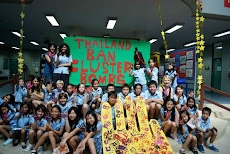
Congratulations to KIS International School, Bangkok
Belated congratulations.
Students at KIS International School in Bangkok held an exhibition on cluster munitions to raise awareness in their school and with the media in advance of Thailand’s week in the 100-day countdown. The students collected about 400 signatures and a created a big hand, on which they collected handprints in support of Thailand signing the CCM. They plan to present these signatures along with letters to the Government of Thailand during Thailand’s week of action at the end of July. Contact: Danield Dunlevie, KIS International School: Danield@kis.ac.th
See more at:http://www.stopclustermunitions.org/news/?id=2306
Students at KIS International School in Bangkok held an exhibition on cluster munitions to raise awareness in their school and with the media in advance of Thailand’s week in the 100-day countdown. The students collected about 400 signatures and a created a big hand, on which they collected handprints in support of Thailand signing the CCM. They plan to present these signatures along with letters to the Government of Thailand during Thailand’s week of action at the end of July. Contact: Danield Dunlevie, KIS International School: Danield@kis.ac.th
See more at:http://www.stopclustermunitions.org/news/?id=2306
Tuesday, September 21, 2010
World Peace Day, 21st September 2010 - RedR Security Management Course
Register of Engineers for Disaster Relief, RedR, provides a high quality international recruitment service for leading aid agencies, governments and the private sector involved in disaster relief.
Its reputation is based on the quality of the candidates supplied and high level of service with 30 years experience recruiting specialist professionals following major emergencies, such as the Asian tsunami or Pakistan earthquake.
RedR operates across a wide range of disciplines, sectors and countries. Through its register of 1,700 highly experienced members it is able to respond to emergencies at short notice.
RedR's training programmes are used by individuals and aid agencies worldwide. From introductory courses for those interested in getting into the sector, to credit-rated training for professionals.
I joined RedR in 1985 and have had various missions over the years. I decided to take their Security Management Course due to the significant rearrangement of global power groups.
On behalf of Peace One Day I invited fellow course members to join in marking the conception of World Peace Day being recognized by United Nations (see picture).
Peace One Day
St George's House
15 St. George's Road
Richmond TW9 2LE
United Kingdom
Tel: +44 20 833 49900
Fax: +44 20 8948 0545
www.peaceoneday.org
Its reputation is based on the quality of the candidates supplied and high level of service with 30 years experience recruiting specialist professionals following major emergencies, such as the Asian tsunami or Pakistan earthquake.
RedR operates across a wide range of disciplines, sectors and countries. Through its register of 1,700 highly experienced members it is able to respond to emergencies at short notice.
RedR's training programmes are used by individuals and aid agencies worldwide. From introductory courses for those interested in getting into the sector, to credit-rated training for professionals.
I joined RedR in 1985 and have had various missions over the years. I decided to take their Security Management Course due to the significant rearrangement of global power groups.
On behalf of Peace One Day I invited fellow course members to join in marking the conception of World Peace Day being recognized by United Nations (see picture).
Peace One Day
St George's House
15 St. George's Road
Richmond TW9 2LE
United Kingdom
Tel: +44 20 833 49900
Fax: +44 20 8948 0545
www.peaceoneday.org
Sunday, September 19, 2010
BBC World News - Peace One Day by Jeremy Gilley
Dear Robert Kinnear
We'd like to invite you to take part in the latest discussions in BBC Global Minds.
This week our featured programme is Peace One Day by Jeremy Gilley.
The film documents Jeremy Gilley's successful attempt to have 21st September recognised as World Peace Day by the United Nations.
Peace One Day will be shown at:
02:10 and 15:10 Saturday 18th September and
09:10 and 21:10 Sunday 19th September.
All times are GMT.
Please click here to leave your comments and feedback on the film.
Paddy O'Connell will be interviewing Jeremy Gilley on Weekend World this weekend so please do tune in to hear what Jeremy has been getting up to since he made Peace One Day.
Have a great weekend,
BBC Tom
MY REPLY TO BBC GLOBAL MINDS
I've been in touch with Peace One Day for a long time and supported them. I have a project about Cluster Bombs which I will promote more on 21st September than usual.
Please view : www.projectpineapple.blogspot.com
I have an entry about my recent trip to Iceland where I visited Yoko Ono's IMAGINE PEACE TOWER in Iceland with a special event this year up there as she celebrates what would have been John Lennon's 70th birthday 9th October. Lennon was of course one of the the earliest vocal peace activists
This week I am taking a course with RedR, Register of Engineers for Disaster Relief, www.redr.org, on Security Management where I will remind everyone about Peace One Day.
Love and Peace
Robert
Make your commitment for Peace Day 2010 here: www.peaceoneday.org
We'd like to invite you to take part in the latest discussions in BBC Global Minds.
This week our featured programme is Peace One Day by Jeremy Gilley.
The film documents Jeremy Gilley's successful attempt to have 21st September recognised as World Peace Day by the United Nations.
Peace One Day will be shown at:
02:10 and 15:10 Saturday 18th September and
09:10 and 21:10 Sunday 19th September.
All times are GMT.
Please click here to leave your comments and feedback on the film.
Paddy O'Connell will be interviewing Jeremy Gilley on Weekend World this weekend so please do tune in to hear what Jeremy has been getting up to since he made Peace One Day.
Have a great weekend,
BBC Tom
MY REPLY TO BBC GLOBAL MINDS
I've been in touch with Peace One Day for a long time and supported them. I have a project about Cluster Bombs which I will promote more on 21st September than usual.
Please view : www.projectpineapple.blogspot.com
I have an entry about my recent trip to Iceland where I visited Yoko Ono's IMAGINE PEACE TOWER in Iceland with a special event this year up there as she celebrates what would have been John Lennon's 70th birthday 9th October. Lennon was of course one of the the earliest vocal peace activists
This week I am taking a course with RedR, Register of Engineers for Disaster Relief, www.redr.org, on Security Management where I will remind everyone about Peace One Day.
Love and Peace
Robert
Make your commitment for Peace Day 2010 here: www.peaceoneday.org
Wednesday, September 8, 2010
IMAGINE PEACE TOWER - Yoko Ono's Tribute to John Lennon
I walked around the platform of native Icelandic stone in reddish ochre, light grey and bluish grey, in a striped mosaic pattern. I walked around the Wishing Well of pure white glass, I touched it, I felt it, IMAGINE PEACE carved in 24 languages.
I walked the pebble beach below IMAGINE PEACE TOWER, the same beach Yoko Ono walked, feeling the energy of the tower, feeling the energy of Yoko, feeling the energy of John.
Beach combing, I found a yellow spade, a little lilac toy bear of determined expression decorated with a heart, a dolphin, a radiant sun face with shades hovering over CALIFORNIA in bright colours.
With my new found cuddly toy and spade, I eased on to the peace platform to enjoy the sun's warmth and imagined peace.
Every year the IMAGINE PEACE TOWER, on Videy Island opposite Reykjavik Iceland, emerges between October 9th (Lennon's birthday) and December 8th (his death day). It also emanates from winter solstice to New Year's day, during the first week of spring and other rare days agreed by the artist.
My ride along the Ho Chi Minh Trail also sat between two dates of note, 30 April, the end of the American War in Viet Nam, 1975 and 20 March, the start of the American War in Iraq, 2003.
Take a look at Yoko Ono's www.imaginepeace.com
I walked the pebble beach below IMAGINE PEACE TOWER, the same beach Yoko Ono walked, feeling the energy of the tower, feeling the energy of Yoko, feeling the energy of John.
Beach combing, I found a yellow spade, a little lilac toy bear of determined expression decorated with a heart, a dolphin, a radiant sun face with shades hovering over CALIFORNIA in bright colours.
With my new found cuddly toy and spade, I eased on to the peace platform to enjoy the sun's warmth and imagined peace.
Every year the IMAGINE PEACE TOWER, on Videy Island opposite Reykjavik Iceland, emerges between October 9th (Lennon's birthday) and December 8th (his death day). It also emanates from winter solstice to New Year's day, during the first week of spring and other rare days agreed by the artist.
My ride along the Ho Chi Minh Trail also sat between two dates of note, 30 April, the end of the American War in Viet Nam, 1975 and 20 March, the start of the American War in Iraq, 2003.
Take a look at Yoko Ono's www.imaginepeace.com
Saturday, August 28, 2010
Politics: Laos Takes Centre Stage in Cluster Bombs Treaty
It's been a while since I added a posting but please access this page of Global Issues highlighting the new position of Laos.
http://www.globalissues.org/news/2010/08/05/6518
Opening paragraph:
After being relegated to the shadows for decades by its more powerful neighbours, Laos is finally taking the lead role in a global campaign to ban the use of cluster bombs.
by Marwaan Macan-Markar (Bangkok)Thursday, August 05, 2010
Inter Press Service
Marwaan is the President of the Foreign Corespondents Club of Thailand, FCCT, to whom I have been continually raising this issue.
http://www.globalissues.org/news/2010/08/05/6518
Opening paragraph:
After being relegated to the shadows for decades by its more powerful neighbours, Laos is finally taking the lead role in a global campaign to ban the use of cluster bombs.
by Marwaan Macan-Markar (Bangkok)Thursday, August 05, 2010
Inter Press Service
Marwaan is the President of the Foreign Corespondents Club of Thailand, FCCT, to whom I have been continually raising this issue.
Friday, June 11, 2010
Obama, BP's Mess and America's Mess
Obama is furious about BP's mess in the Gulf of Mexico and rightly so. Lucky for him it was not an American oil company. Mind you, he seems to be overlooking the fact that BP bought Amoco, American Oil Company, in 1998 and all its American assets including personnel who were prominent in this current fiasco. Is Obama in this new political zest for cleaning up America's mess overlooking American military waste in Indochina that has been adversely affecting lives there for 40 years, not just reducing their income but reducing their lifespan? What if Laos, Viet Nam and Cambodia decided it was time to put their foot on America's neck and insist they clean up their mess and not one penny to be picked up by their governments and taxpayers and every one affected by the contamination by UXO's sue the American government for loss of life and livelihood in a xenophobic frenzy? Ha, that'll be the day Democracy reaches the United States of America.
Wednesday, June 9, 2010
Educating Nate Thayer by Al Rockoff and Project Pineapple
Nate Thayer came over to say hi. There were only staff in the FCCT, Foreign Correspondents Club of Thailand, no customers. He didn't need to introduce himself by name. This is the man who interviewed Pol Pot after an 18 year absence, the same year he died. He also interviewed Duch, the executioner of thousands in torture camps, found by photographer Nick Dunlop working for ARC, American Refugee Committee. Duch is presently being tried for Crimes Against Humanity, awaiting sentencing. I worked for ARC 1998-1999 on the Cambodian border supplying two refugee camps with water.
It was during the Red Shirt occupation of down town commercial centre of Bangkok in which FCCT is located that we met and hung out for a couple of weeks last month, May. I rode my bike through two Red Shirt check points to an empty car park surrounded by a linked barrier fence. The bike is of course not the Minsk which I sold in Phnom Penh last year but my old faithful Yamaha DT 200. Built for dirt track, it works well in this city riding through the sunken manhole covers and drains, mounting the high kerbs when the traffic jam is too dense to get through. Whizz along the pavements through accommodating pedestrians. Everyone does it, if they've got big wheels.
In pursuit of Pol Pot and other stories, Nate had made a heavily armed elephant ride, a convoy of four, the only way to safely travel through Cambodia's Ratanakiri Province during the Khmer Rouge strife. This is the intersection point. I too had ridden my Minsk along unpaved trails somewhat improved through the same territory only last year in search of a different story, one generation earlier. The Viet Nam story of the Ho Chi Minh Trail and it being carpet bombed with clusters.
"Clusters bombs?" Nate questioned, being more familiar with the widespread use of landmines in the Khmer Rouge war mongering days. "Yes" chipped in Al, "along the Ho Chi Minh trail in the north east and around Phnom Penh too". Al Rockoff is an old Cambodia and Viet Nam hand, a respected photographer. He's the one played by John Malkovich in the Killing Fields. Have a look: http://en.wikipedia.org/wiki/Al_Rockoff
So there you are. Project Pineapple's purpose was to raise awareness of the Cluster Bomb issue. A well worn journalist such as Nate who was focused on the Khmer Rouge problem with Pol Pot and Duch was surprised to learn of their use in Cambodia. Imagine the ignorance remaining in the minds of most who have far less possibility to be aware.
So children in the carpert bombed areas continue to die every month, around 10 'on average'. Now at least one more is aware of this little publicised fact, Nate Thayer.
To read Nate's story go to: http://www.cybercambodia.com/dachs/killing/polpot.html
Among his peers, Nate Thayer is known as "a man with a mission, a mobile, and an AK-47". In his yet to be published book, Sympathy For the Devil, he recounts his search for Pol Pot, Duch and other tales. Nate kindly offered me some sections of the manuscript over which to cast an eye. A good read.
It was during the Red Shirt occupation of down town commercial centre of Bangkok in which FCCT is located that we met and hung out for a couple of weeks last month, May. I rode my bike through two Red Shirt check points to an empty car park surrounded by a linked barrier fence. The bike is of course not the Minsk which I sold in Phnom Penh last year but my old faithful Yamaha DT 200. Built for dirt track, it works well in this city riding through the sunken manhole covers and drains, mounting the high kerbs when the traffic jam is too dense to get through. Whizz along the pavements through accommodating pedestrians. Everyone does it, if they've got big wheels.
In pursuit of Pol Pot and other stories, Nate had made a heavily armed elephant ride, a convoy of four, the only way to safely travel through Cambodia's Ratanakiri Province during the Khmer Rouge strife. This is the intersection point. I too had ridden my Minsk along unpaved trails somewhat improved through the same territory only last year in search of a different story, one generation earlier. The Viet Nam story of the Ho Chi Minh Trail and it being carpet bombed with clusters.
"Clusters bombs?" Nate questioned, being more familiar with the widespread use of landmines in the Khmer Rouge war mongering days. "Yes" chipped in Al, "along the Ho Chi Minh trail in the north east and around Phnom Penh too". Al Rockoff is an old Cambodia and Viet Nam hand, a respected photographer. He's the one played by John Malkovich in the Killing Fields. Have a look: http://en.wikipedia.org/wiki/Al_Rockoff
So there you are. Project Pineapple's purpose was to raise awareness of the Cluster Bomb issue. A well worn journalist such as Nate who was focused on the Khmer Rouge problem with Pol Pot and Duch was surprised to learn of their use in Cambodia. Imagine the ignorance remaining in the minds of most who have far less possibility to be aware.
So children in the carpert bombed areas continue to die every month, around 10 'on average'. Now at least one more is aware of this little publicised fact, Nate Thayer.
To read Nate's story go to: http://www.cybercambodia.com/dachs/killing/polpot.html
Among his peers, Nate Thayer is known as "a man with a mission, a mobile, and an AK-47". In his yet to be published book, Sympathy For the Devil, he recounts his search for Pol Pot, Duch and other tales. Nate kindly offered me some sections of the manuscript over which to cast an eye. A good read.
One Year Anniversary, the Minsk
It has just passed. At the end of May last year I rode into Phnom Penh to end the over 7000 kilometer ride along the Ho Chi Minh Trail through Laos, Viet Nam and Cambodia to help raise awareness of the Cluster Bomb issue. It was planned only to be about 3500 kilometers but with invitations and detours it extended. Ride one, get one free.
The final few hundreds of meters brought me to a guest house not far from Phnom Penh Post. To my surprise, I saw two other Minsk motorbikes sitting outside. Chatting with the guys they said a friend was arriving soon looking to buy one too. Saddle sore, I gladly offered my Minsk.
Next day while hugging the toilet with my only bout of bad belly, another guy whom I'd helped repair his Yamaha turned up with Aussie Tom looking for a Minsk. After talking to his Dad back home and viewing this blog he agreed to buy it.
Next day, yahoo, I was on a bus to Angkor Wat. It was raining so, yahoo, I didn't have to take shelter. I could doze without the possiblity of being wiped out by ten wheeled truck, yahoo. I was grateful to Tom for relieving me of my extended marathon.
Earlier this year I was on a trip in Indonesia. While walking along the beach road in south Kuta, Bali, noticing the developments from three years earlier, through my day dreaming I heard, Robert, then more loudly, ROBERT, as a hand came down on my right shoulder. It was Tom. A great reunion with him and his brother.
Tom was refused exit by the Cambodian border guards. He was aware of the 1500 kilometer detour I had to make coming from the Vietnamese side. He ignored the guards and pushed the Minsk through to the Vietnamese side. The Cambodians called him back only to stamp his passport. Ha, attaboy, he was on his way. The Minsk had Vietnam plates so possible to do it that direction.
After two months of touring Vietnam with his two friends, Tom sold the Project Pineapple Minsk in Hanoi. Who knows where it is now. Anybody know?
The final few hundreds of meters brought me to a guest house not far from Phnom Penh Post. To my surprise, I saw two other Minsk motorbikes sitting outside. Chatting with the guys they said a friend was arriving soon looking to buy one too. Saddle sore, I gladly offered my Minsk.
Next day while hugging the toilet with my only bout of bad belly, another guy whom I'd helped repair his Yamaha turned up with Aussie Tom looking for a Minsk. After talking to his Dad back home and viewing this blog he agreed to buy it.
Next day, yahoo, I was on a bus to Angkor Wat. It was raining so, yahoo, I didn't have to take shelter. I could doze without the possiblity of being wiped out by ten wheeled truck, yahoo. I was grateful to Tom for relieving me of my extended marathon.
Earlier this year I was on a trip in Indonesia. While walking along the beach road in south Kuta, Bali, noticing the developments from three years earlier, through my day dreaming I heard, Robert, then more loudly, ROBERT, as a hand came down on my right shoulder. It was Tom. A great reunion with him and his brother.
Tom was refused exit by the Cambodian border guards. He was aware of the 1500 kilometer detour I had to make coming from the Vietnamese side. He ignored the guards and pushed the Minsk through to the Vietnamese side. The Cambodians called him back only to stamp his passport. Ha, attaboy, he was on his way. The Minsk had Vietnam plates so possible to do it that direction.
After two months of touring Vietnam with his two friends, Tom sold the Project Pineapple Minsk in Hanoi. Who knows where it is now. Anybody know?
Tuesday, May 11, 2010
Heaven and Earth Movie Based on Le Ly's True Life Story
Le Ly was at the photo shoot when I met Oliver Stone for the first time. Well, actually in was the second time. Back in 1992, Heaven and Earth starring Tommy Lee Jones was being shot in Phuket. I was selected, while playing an 'extra', for a walk by so Stone could decide if I was suitable for another part. No is the answer.
Le Ly invited me to the Open Forum, Psychosocial Response to Disasters Focus on Children in Asia held next day after Stone's FCCT presentation. Her traumatic experiences while a child, her due recovery and ability to deal with life in such a positive and constructive manner proved to be inspirational to the forum.
She founded East Meets West Foundation then moved on to found Global Village Foundation focusing on sustainable community, development projects, www.globalvillagefoundation.org
Some of this work covers areas affected by Cluster Bombs in Viet Nam
Le Ly invited me to the Open Forum, Psychosocial Response to Disasters Focus on Children in Asia held next day after Stone's FCCT presentation. Her traumatic experiences while a child, her due recovery and ability to deal with life in such a positive and constructive manner proved to be inspirational to the forum.
She founded East Meets West Foundation then moved on to found Global Village Foundation focusing on sustainable community, development projects, www.globalvillagefoundation.org
Some of this work covers areas affected by Cluster Bombs in Viet Nam
Subscribe to:
Posts (Atom)
Another Good Reason for Name Project Pineapple

This cluster bomb, known as a pineapple, which is still active, is in the collection of Tourist Information at Phonsavan, Plain of Jars, Laos
Two Good Reasons for Image on Project Pineapple Logo

Cope publicity staff Soksai 'plays' Project Pineapple logo
Mr Ta, No Arms One Eye, Cluster Bomb Victim

This is what the ride is about, to stop the perpetrators of these weapons
An Animated Mr Ta Gesticulates....

....as best he can during interview with COPE's Cluster Bomb display behind
'Handling' His Misfortune by Selling Maps at War Museum, Sai Gon

This victim armless, one legged, one eye, is pragmantic, I shook his 'hand' with both of mine
Arms and Legs All Over The Place

That's COPEs limb fitting centre, not going out of business soon, unfortunately.
Colourful Collection of Cluster Bombs

A tasty collection, you can see why kids enjoy playing with them
Togehter We Can Make It Happen

Bomb Awareness Day in Vientiane, is that an American flag I see before mine eyes?
Out of Nong Across to Along and The Hardest Trail

The Along villagers build this crossing during the dry season with a hefty toll on the otherside
War Vet Wonders Where The Good Times Went, And His Leg

The restrained display opposite the City Opera House on Le Loi Avenue, Sai Gon
International Artist Supports Project Pineapple
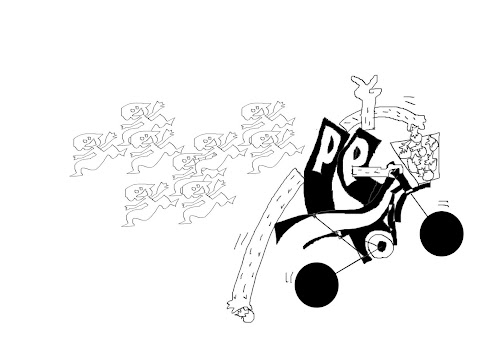
Man Winkler's contribution to the project , see blog entry, April 22
Little Remains After 40 Years of Scrap Hunters

Too big with rusted bolts for the recycling confirms you are on the Trail
Forest Fire

Sunset on Lao at the Viet Nam border. Imagine these skies on real fire 40 years ago.
Descendant of First Generation Clearance Team

Pigs, Dogs and Children were the first to clear UXOs before western conscience finally activated, see website
Jettisoned Fuel Tank Takes to the Air Again

B52s dropped their supplimentary fuel tanks after their deadly Cluster Bomb missions
UXO Lao Xekong meet Project Pineapple

Mr Tawee and some of his crew receiving COPE's brouchures
Mountain Villagers Have Little But The Land They Live On

Why should these people be suffering from the war remants so flagrantly scattered 40 years ago?
Complex Weaving Designs Take a Complex Comprehension

Villagers skilled in weaving intricate designs easily capable of searching their mountainous forest floor plan
Unstoppable Road Development of the Ho Chi Minh Trail

Parking a Minsk even for a moment can be hazardous
Minsk 125cc 2002
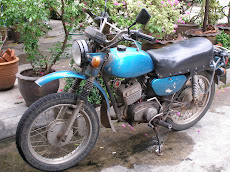
Your going on that? remarked Tony, the web man.
What's that Minsk doing up there?

It's on the way to my 'local' mechanic in Luang Prabang of course.
My 'Local' Mechanic

Hey Joe, Second Gear, not Top Gear
A Jarring Ride

Phonsavan, Pathet Lao stronghold
Hanoi, Minsk's Second Fix

Snagging repairs after first fix
The Ride Kickstarts

Project Pineapple departs from Bach Mai Hospital, Hanoi
The Big House Pitstop

Not reaching the start of the Ho Chi Minh Trail on the first day we make a pitstop at this fine traditional Big House.
Cam Thuy, Start of the Ho Chi Minh Trail

Outside the restaurant, our last meal together before they head north and I south
Project Pineapple Riders

Ben from Australia, with 32 biking trophies to his name, rides the Minsk in Hanoi
Ho Chi Minh's Birth Place

Not far off the Trail to which he gave it's name, Uncle Ho's house
Phong Nga Cave's now Toothless Mouth

Like Venice, Cave Gondaleers have time
Spooked at Trail Crossroads

Tien with Jokers Alain and Ludivec
Moody Mountains of Mordor

The Spooky crossroads of the Trail
Friendly French

Missing a gear change causes a photo op returning to the caves
Chain of Events cause Delays

Tuan speedily replaces clutch and drive chain